
Blue nitrile gloves are among the most recognizable disposable gloves and are used in many professional work environments. They are seen, among other things, in food handling, cleaning, production, clinics and other areas where hygiene and practical hand protection are important.
But why are many nitrile gloves blue, and does the color matter for the glove's properties?
In this guide, we review the use of blue nitrile gloves, what you need to be aware of when coming into contact with food, and how to choose the right glove for the work task.
What are blue nitrile gloves?
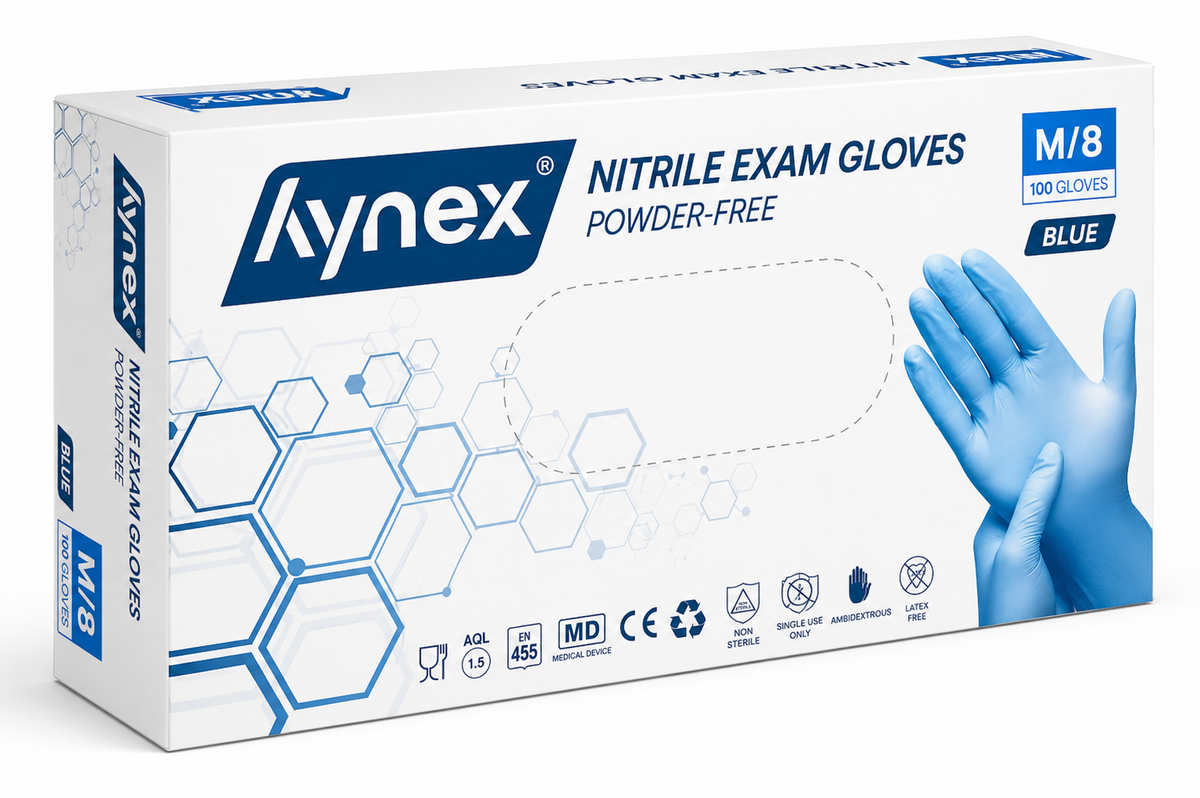
Blue nitrile gloves are disposable gloves made from synthetic nitrile rubber.
Nitrile does not contain natural rubber latex and is used to make disposable gloves in many different thicknesses, sizes and colors.
The blue color is widespread in professional environments, but the color itself is not a certification or documentation of the glove's properties.
It is always the specific model, its specifications and documentation that determine which tasks the glove is suitable for.
Where are blue nitrile gloves used?
Blue nitrile gloves are used across a number of industries.
It can be, among other things:
- Food production and food handling
- Restaurants and commercial kitchens
- Catering
- Cleaning
- Industry and production
- Clinics and care
- Laboratories
- Warehouse and logistics
The requirements for the glove can be very different from industry to industry. Therefore, companies should choose nitrile gloves based on the specific work task rather than color alone.
Why are blue gloves used in the food industry?
Blue gloves are very visible in many food environments.
The clear color can, among other things, make the glove easier to identify visually in a production environment compared to more neutral colors.
But an important point is:
A blue nitrile glove is not automatically food approved just because it is blue.
If a glove is to be used for food contact, the company must check the documentation of the specific model and ensure that it is suitable for the intended use.
Can nitrile gloves be used for food?
Nitrile gloves are available in models, that are intended for various types of professional use, including food handling.
However, the decisive factor is the concrete glove.
When choosing gloves for food, the company should examine, among other things:
- Whether the glove is documented as suitable for food contact
- What conditions it is intended for to
- Which types of food it may be used with
- Manufacturer's instructions for use and documentation
- Whether restrictions apply to the specific model
You should therefore not use designations such as "nitrile" or "blue" as a substitute for checking the product documentation.
Blue nitrile gloves for cleaning
Blue nitrile gloves are also used for various cleaning tasks.
In general work tasks, a disposable glove can provide a practical barrier between the hands and the surroundings.
If the employee works with cleaning chemicals, disinfectants or other chemical products, the documented resistance of the specific glove must be checked.
Not all nitrile gloves protect against all chemicals.
Blue nitrile gloves for industry and production
Nitrile gloves are also used for various lighter tasks within industry and production, where there may be need for finger sensitivity and frequent glove changes.
For more demanding work tasks, a stronger nitrile glove may be relevant.
In the case of risk of, for example, cuts, strong mechanical impact or certain chemicals, a completely different type of work glove may be needed.
Blue or black nitrile gloves - what is the difference?
The most obvious difference is the color.
One cannot conclude that a black nitrile glove is stronger than a blue one, or that a blue glove provides better hygiene or protection.
Two nitrile gloves in different colors can have very different specifications.
Compare therefore in instead:
- Thickness
- Fit
- Size
- Surface and grip
- Documented properties
- Certifications and standards
- The intended use
The color may be practical or desired in certain industries, but The product documentation is crucial.
Which thickness should you choose?
Nitrile gloves come in different thicknesses and weight classes.
A lighter model may be relevant for tasks with a focus on finger sensitivity and frequent glove changes.
A stronger nitrile glove may be relevant for tasks where a more robust disposable glove is desired.
However, the strongest glove is not automatically the best for all tasks. Comfort, finger feel and the specific application must also be included in the selection.
Which size nitrile glove should you choose?
A correct size is important for both comfort and function.
A glove that is too large can reduce finger feel. A glove that is too small can fit too tightly and strain the material unnecessarily.
Companies with several employees should therefore have relevant sizes available.
Blue nitrile gloves for business
Companies with a large consumption of disposable gloves should look at more than just the purchase price.
It is also relevant to compare size, thickness, number of gloves per box, documentation, area of application and actual consumption.
Nordic Safety offers nitrile gloves in various sizes, thicknesses and colors for professional companies.
See all nitrile gloves with current sizes and prices. Select color and size on the product page. For use with food: also read the guide on documentation for gloves for food.