Nitrile gloves are often used for professional cleaning, where employees work daily with water, dirt, detergents and various surfaces.
But not all nitrile gloves are the same, and the right glove depends, among other things, on the work task, how long the glove is to be used, which products the employee comes into contact with, and what requirements are placed on finger feel and protection.
In this guide we review what you should pay attention to when choosing Nitrile gloves for cleaning.
Why use nitrile gloves for cleaning?
Nitrile gloves are made from synthetic nitrile rubber and come in many different thicknesses, sizes and designs.
For cleaning tasks, disposable gloves can be practical because they can be used for limited tasks and then changed.
Nitrile gloves do not contain natural rubber latex and can at the same time offer a combination of fit, finger feel and mechanical strength.
This makes nitrile relevant for many professional cleaning tasks.
What cleaning tasks can nitrile gloves be used for?
Nitrile gloves are used, among other things, in for:
- Commercial cleaning
- Office cleaning
- Hotel and hospitality
- Restaurants and commercial kitchens
- Institutions
- Clinics
- Industry and production
- Workshops
- Property service
- Sanitary areas
However, the specific glove must always be chosen according to the work task.
There can be a big difference between light surface cleaning and work with concentrated cleaning chemicals.
Do nitrile gloves protect against cleaning agents?
Nitrile can have resistance to various substances, but this does not mean that all nitrile gloves protect against all cleaning agents or chemicals.
If the employee works with chemical cleaning products, the company must check the specific glove's documentation.
It is, among other things, relevant to look at:
- Which chemical is used
- The product's concentration
- Duration of contact
- Glove material and thickness
- Manufacturer's documentation
- Relevant standards and test results
For more demanding chemical handling, a standard disposable nitrile glove may be insufficient and another type of chemical protection glove may be necessary.
Thin or strong nitrile gloves for cleaning?
Nitrile gloves are available in different thicknesses and weight classes.
A lighter nitrile glove may be relevant for short-term tasks where finger sensitivity and freedom of movement are prioritized.
A stronger nitrile glove may be relevant for more demanding cleaning work where a more robust disposable glove.
However, the thickest glove is not necessarily the best for all work tasks.
The choice should be based on the overall combination of comfort, work task, durability and documented properties.
Which size should the employee use?
Correct size is important, especially when the gloves are used many times during the the working day.
A glove that is too small can fit unnecessarily tight and stress the material.
A glove that is too big can reduce finger sensation and make it more difficult to handle rags, bottles, utensils and other cleaning equipment.
Professional cleaning companies should therefore have appropriate sizes available for employees.
Black or blue nitrile gloves for cleaning?
Both black and blue nitrile gloves can be used for various professional tasks.
The color alone does not say anything for sure about the glove's strength, thickness or level of protection.
A black nitrile glove can be thinner than a blue model and vice versa.
Therefore choose the glove according to the specifications and the work task rather than just the color.
When should nitrile gloves be changed?
Disposable gloves are intended for limited use and must be changed as needed.
It may be necessary to change gloves, among other things:
- When the glove becomes damaged
- If the glove becomes visible contaminated
- When changing between work tasks
- When there is a risk of cross-contamination
- According to the manufacturer's instructions
- When the specific work situation requires it
Using disposable gloves does not replace proper hand hygiene either.
Nitrile, latex or vinyl for cleaning?
There are several types of disposable gloves for professionals work tasks.
Nitrile is a synthetic material and is widely used for professional tasks.
Latex is known for high elasticity and good fit, but contains natural rubber latex.
Vinyl may be relevant for certain lighter and short-term work tasks.
The best choice depends therefore of the work task and the specific glove's documentation.
Nitrile gloves for professional cleaning companies
For cleaning companies with a large monthly consumption, even small differences in price and consumption can have an impact on the total costs.
It is therefore relevant to compare:
- Price per glove
- Number of gloves per box
- Thickness
- Sizes
- Durability during the specific work task
- Documentation
- Delivery security
- The actual monthly consumption
A cheaper glove is not necessarily the cheapest solution overall if the employee has to change it significantly more often.
Checklist before purchasing for professional cleaning
When in contact with cleaning chemicals, the glove must be chosen based on the specific chemical risk and the manufacturer's documentation – not just color or gram weight. Use this short check:
- Find the cleaning agent's safety data sheet. Read especially point 8.2 on personal protection. Here, among other things, relevant glove material, thickness and penetration time are described.
- Check the glove's documentation. Examine whether the specific model is suitable for the agent, the concentration, the duration of contact and the working method. A standard reference alone is not proof of resistance to all chemicals.
- Assess whether gloves are sufficient at all. Follow the chemical risk assessment and consider substitution, changed work methods and technical measures before personal protective equipment.
- Plan glove changes and training. Introduce simple instructions for correct use, replacement, disposal and hand hygiene.
Official Danish sources: The Norwegian Arbejdstilsynet on safety data sheets and glove protection and The Norwegian Arbejdstilsynet on chemical risk assessment.
The guide is general purchasing and safety information and does not replace the chemical risk assessment of the workplace or the specific product documentation.
Buy nitrile gloves for cleaning at Nordic Safety
Nordic Safety supplies nitrile gloves, disposable gloves and cleaning articles to professional companies.
We offer different nitrile gloves in several sizes, colors and thicknesses, so that the company can choose a model according to the work task and the specific consumption.
See nitrile gloves for professional cleaning, and compare with cleaning agents and cleaning articles for business. The chemical resistance of the product must be suitable for the specific work task.
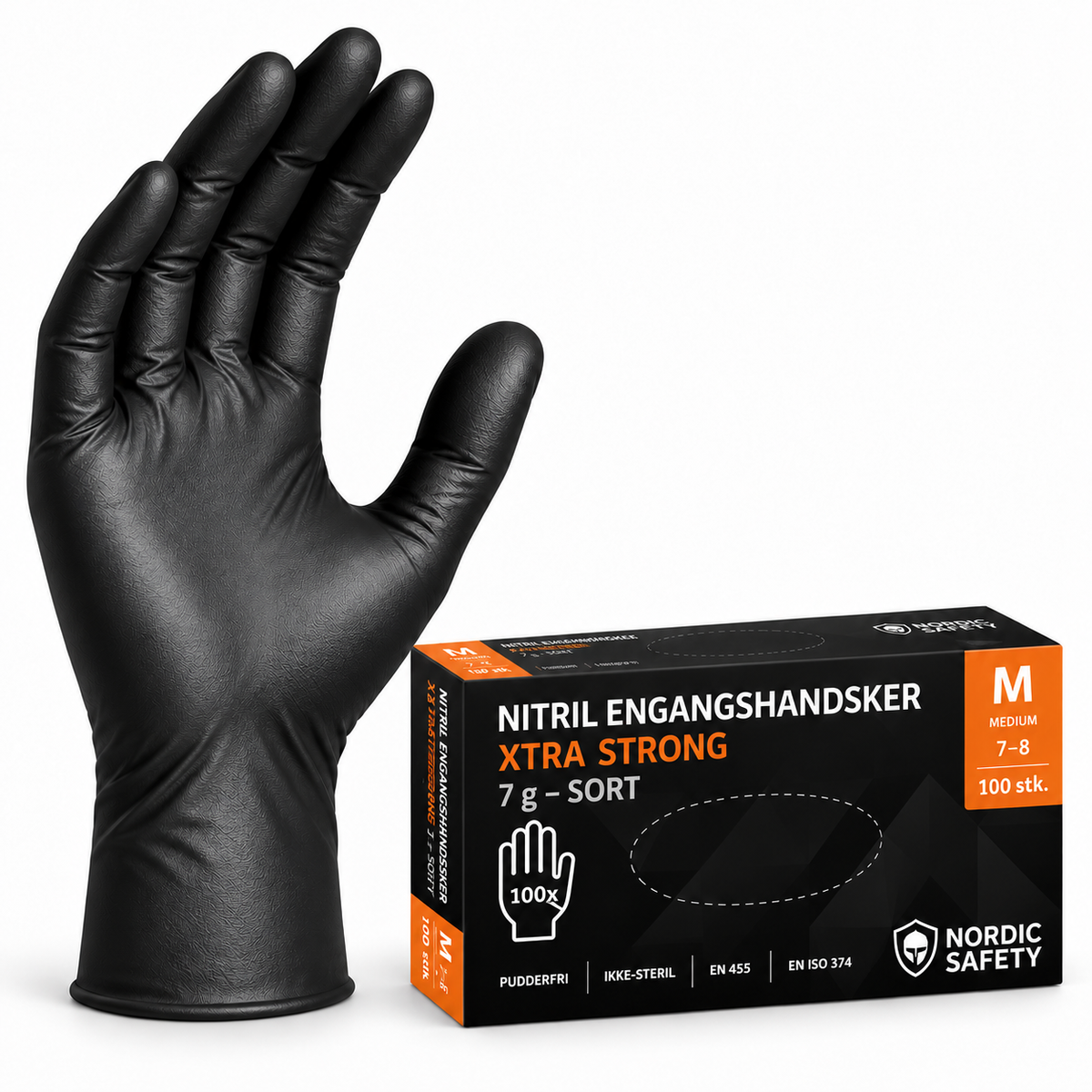
Compare models: nitrile gloves 5 g and extra strong nitrile gloves 7 g. Chemical resistance must always be documented for the specific task.