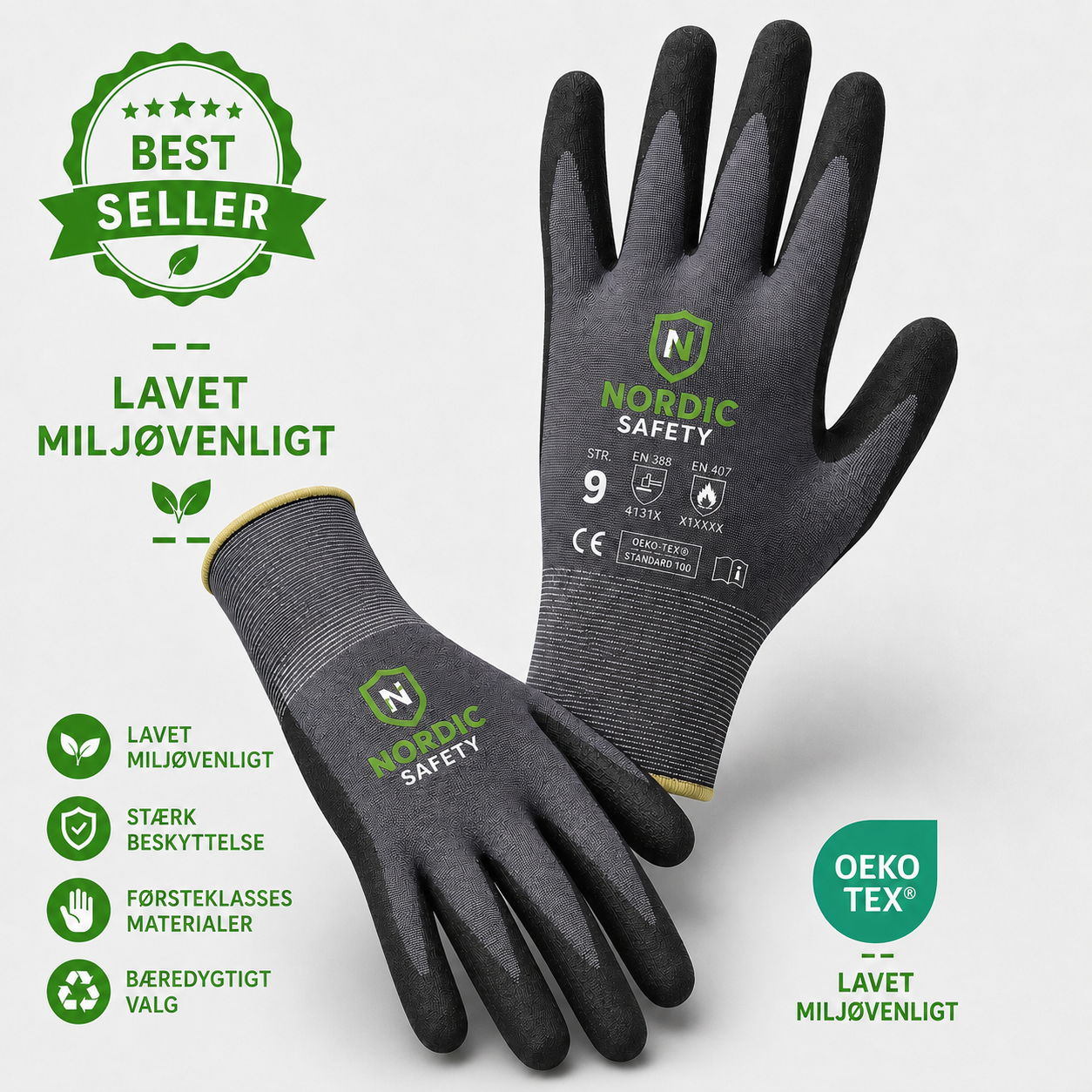


The right work gloves can make a big difference to both safety, comfort and efficiency during the working day. Regardless of whether you work in a workshop, warehouse, construction site, in industry or with assembly, the glove should be chosen according to the specific work task.
There are many different types of work gloves, and the strongest glove is not necessarily the best. For precision work, finger feel and fit can be crucial, while durability, grip and mechanical protection can be more important for heavier work.
In this guide, we review the most important factors when choosing work gloves for professional use.
What are work gloves?
Work gloves are gloves designed to protect the hands during various types of work. Depending on the model, they can, among other things, be designed to provide a better grip, protect against mechanical impact or make it more comfortable to handle materials and tools.
There is therefore no single work glove that is optimal for all work tasks.
A fitter who works with small components has different needs than an employee who handles building materials or works with heavy objects in a warehouse.
The first question should therefore always be:
What work task should the glove be used for?
How do you choose the right work gloves?
When you compare work gloves, you should look at, among other things:
- the work task
- the need for finger feel
- grip
- fit and size
- wearability
- materials
- working environment
- relevant standards and documented properties
For lighter assembly work, a thin and flexible glove can be advantageous. For more demanding work, a stronger construction or a glove with specific protective properties may be needed.
It is therefore important to choose according to use rather than solely price.
Work gloves for assembly and precision work
During assembly work, good dexterity is often one of the most important characteristics.
If the employee has to handle screws, tools, spare parts or other smaller components, a very strong glove can make work unnecessarily difficult.
A good assembly glove should typically combine:
good fit + flexibility + grip + finger feel.
This can make this type of work glove relevant in, for example, production, storage, assembly, craft and light industry.
Work gloves for workshops and mechanic
In a workshop, the hands are exposed to many different work tasks during the day.
This can, for example, be handling tools, spare parts and various components.
A secure grip and good finger sensitivity are often important here.
For some tasks, reusable work gloves may be the best choice, while nitrile gloves may be relevant for other work tasks where a thin disposable glove.
It is therefore common for professional workshops to use several different glove types depending on the work task.
Work gloves for warehouse and logistics
Employees in warehouse and logistics can handle very large quantities of goods in a working day.
Cartons, packaging, pallets and various products must be lifted, moved and sorted.
Work gloves with a good grip and high comfort can be an advantage here.
If the glove is to be used through large parts of the working day, the fit becomes important at the same time. A glove that fits badly can be a nuisance and make precision work more difficult.
Therefore, companies should not only look at the purchase price per pair, but also on how well the glove works for the employees' specific work tasks.
Work gloves for construction and crafts
Within construction and crafts, the need varies considerably depending on the work task.
An electrician, carpenter, fitter and contractor perform different types of work and may therefore need different gloves.
When choosing work gloves, the company should assess the specific risks and then check the manufacturer's documentation and relevant standards for the glove in question.
For some work tasks, flexibility and dexterity are essential. For others, mechanical protection and abrasion resistance are more important.
What does EN 388 mean?
When researching work gloves for mechanical tasks, you will often come across the designation EN 388.
EN 388 is a European standard used for testing and classifying the properties of protective gloves in connection with mechanical risks.
Depending on the product, the labeling may include information related to wear, cutting, tearing and punctures.
This does not mean that all work gloves have the same protection.
Therefore, always check the specific model's labeling, data sheet and manufacturer documentation when a specific protection class is required. Read our separate guide to understanding the EN 388 code.
Grip is important when choosing work gloves
A good grip can be decisive, especially if the employee handles tools or materials many times during the working day.
Work gloves are therefore manufactured with different types of coatings and surfaces.
The choice should depend on the working environment and the material being handled.
For example, it is not necessarily the same glove that works best for dry components as for work tasks where the surfaces may be smooth.
Fit and size
An often overlooked factor is size.
A work glove that is too large can reduce finger feel and make precision work more difficult.
A glove that is too small can feel tight and restrict freedom of movement.
The correct size should provide a close and comfortable fit without unnecessarily restricting hand movements.
If several employees use the same glove model, it may therefore be appropriate to have several sizes available.
Should you order for several employees? Use our guide to the size distribution of work gloves to go from a tested fit to a concrete order.
Work gloves or disposable gloves?
It depends entirely on the work task.
A traditional work glove is often intended for repeated use and can be relevant for, among other things, assembly, warehouse work, craftsmanship and mechanical work.
A disposable glove , on the other hand, is typically used for shorter tasks, where hygiene or the need for frequent glove changes play a role.
Nitrile gloves, for example, are widely used as disposable gloves in a wide range of professional industries.
Many companies therefore have both work gloves and disposable gloves in stock.
Which material should you choose?
Work gloves can be made from a wide range of materials and material combinations.
You can, among other things, come across models with different textile fibers, synthetic materials and coatings.
The choice of material affects properties such as flexibility, grip, comfort and wear resistance.
That is why you should not choose work gloves based on the name of the material alone. Instead, look at the entire construction of the glove and the documented properties.
How long do work gloves last?
There is no one specific number of hours or working days that applies to all work gloves.
The durability depends on, among other things:
the work task, the load, the material, the construction of the glove and how often are used.
A glove should be replaced if it is damaged, worn or no longer provides the necessary protection or function.
During professional use, the condition of the gloves should therefore be checked regularly.
Work gloves for companies
For companies with many employees, gloves can be a significant ongoing consumable.
It makes it important to find the right balance between:
price, quality, comfort and durability.
The cheapest glove per pair is not necessarily the cheapest solution in practice if it has to be replaced significantly more often.
Companies with a large consumption can therefore benefit from standardizing a few glove models for different work tasks and buying them in larger quantities.
At the same time, it makes reordering and inventory management easier.
Find work gloves at Nordic Safety
Nordic Safety supplies work gloves, disposable gloves and other consumables to professional companies.
We focus on products for companies that need easy ordering, competitive prices and fast delivery.
See work gloves for business and current prices. For precision work, you can also see active PU assembly gloves. First clarify requirements for protection and fit.
Frequently asked questions about work gloves
Which work gloves are best?
There is no one work glove that is best for all work tasks. The right choice depends, among other things, on the working environment, requirements for grip, finger feel, abrasion resistance and necessary protection.
Which work gloves should you use in the workshop?
It depends on the work task. In mechanical work, grip, abrasion resistance and finger feel may be important, while nitrile gloves may be relevant for other types of tasks.
What is EN 388?
EN 388 is a European standard used in connection with protective gloves against mechanical risks. Always see the individual glove's specific classification and documentation.
How do I find the right size work gloves?
The glove should fit comfortably around the hand without being so tight that movement is limited, or so loose that finger sensation is reduced.
Can work gloves be used several times?
Many work gloves are intended for repeated use use, but it depends on the product and the work task. Damaged or worn gloves should be replaced.
See popular work gloves: Premium Sandy Flex and THOR Flex Basic for comparison of fit and grip.